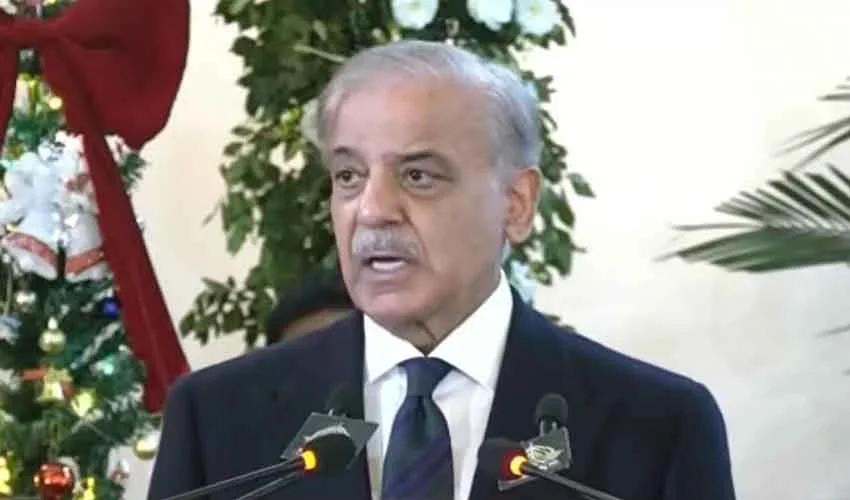
Prime Minister Shehbaz Sharif has said that restoring economic stability was a challenging and demanding task, but the government successfully pulled the country back from the brink through determined and far-reaching economic reforms.
Addressing the launching ceremony of Economic Governance Reforms, the prime minister recalled the situation when his government assumed office in 2024. He said Pakistan was facing severe economic stress at the time, with soaring inflation, rising debt repayment pressures, and a fragile overall economic environment.
PM Shehbaz noted that under those difficult circumstances, the government was left with no option but to take tough and unavoidable decisions. He acknowledged that many of these measures were politically costly and unpopular, but stressed that they were taken purely in the national interest to safeguard the country’s future.
He said the government deliberately shifted its focus from short-term survival to achieving long-term economic stability and sustainable growth. According to him, delaying reforms any further would have pushed Pakistan deeper into crisis and further away from development goals.
Highlighting key initiatives, the prime minister said bold steps such as privatization were finally undertaken, despite such reforms being neglected for decades. He added that years of inaction had made structural changes unavoidable, leaving the government with little room to delay difficult decisions.
PM Shehbaz revealed that the reform framework includes 59 priority reforms, 83 supplementary reforms, and the active involvement of 58 implementing institutions. He said these coordinated efforts played a critical role in steering Pakistan out of the economic crisis and placing it back on a path of stability.
“For the first time, we introduced a home-grown reform agenda designed in line with Pakistan’s best interests,” the prime minister said. He explained that while international financial institutions provided support, the reform strategy itself was locally developed to ensure long-term sustainability and national ownership.
The prime minister emphasized that consistent and rapid implementation of the reform agenda is essential for future progress. He highlighted major governance improvements, including the digitalization of the Federal Board of Revenue (FBR), which for the first time moved away from a paper-based system. He also pointed to the successful implementation of the e-procurement system, which faced legal hurdles for years before being operationalized.
Stressing accountability, PM Shehbaz said the government remains fully answerable to the nation. He praised the collective efforts of federal institutions, ministers, and government officials, stating that such comprehensive reforms could not have been achieved without teamwork and institutional coordination.
“This is a difficult and demanding journey,” he said, adding that Pakistan will face challenges “as vast as oceans” in its pursuit of economic growth. He acknowledged that the path already traveled was filled with hardship and sacrifice.
Concluding his address, the prime minister expressed confidence that continuous hard work, dedication, and commitment would ultimately bring success. He reiterated that economic reforms are a nationally owned agenda, with global institutions extending cooperation to support Pakistan’s economic revival.