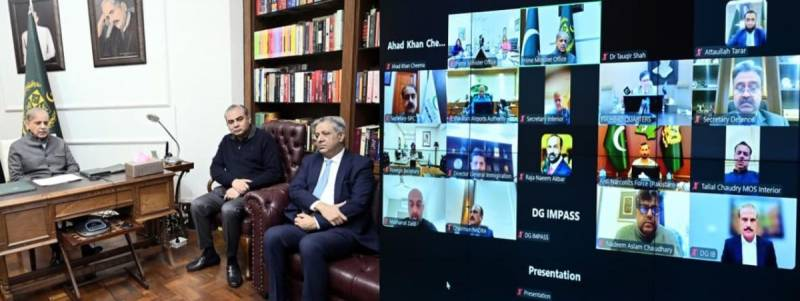
Prime Minister Shehbaz Sharif has directed authorities to fully utilize modern technology to strengthen Pakistan’s immigration system, stressing the need for efficiency, transparency, and fairness. The instructions were issued during a high-level review meeting focused on combating human trafficking and addressing challenges linked to illegal travel abroad.
While chairing the meeting, the prime minister appreciated the efforts of relevant institutions working to curb human trafficking networks. He also took note of recent complaints related to the off-loading of passengers at airports and praised Federal Interior Minister Mohsin Naqvi for personally visiting airports to assess the situation firsthand.
Prime Minister Shehbaz emphasized that strict action must continue against individuals attempting to travel abroad illegally or using suspicious documentation. However, he made it clear that passengers holding valid travel documents should not face unnecessary inconvenience during screening or enforcement measures.
The prime minister instructed authorities to further improve the performance of the Protectorate of Emigrants. He stressed the importance of stronger coordination between the Federal Investigation Agency (FIA), the Protectorate of Emigrants, and other relevant departments to facilitate Pakistanis traveling abroad legally for employment and other legitimate purposes.
He also ordered strict action against corrupt elements within the system, underlining that corruption undermines public trust and weakens national efforts to control illegal migration. Transparency and efficiency, he said, must remain central to all immigration-related processes.
During the briefing, officials informed the prime minister that significant progress had been made against illegal travel. The FIA has arrested 451 individuals involved in human trafficking and unlawful migration so far this year. As a result of these actions, illegal travel by Pakistanis to Europe has reportedly declined by 47 percent.
Authorities also reported a reduction in cases involving travel on forged or illegal documents to the United Kingdom and Gulf countries. Despite these improvements, misuse of work, visit, and tourist visas, along with off-loading and deportation issues, remain major challenges, particularly in European destinations.
The briefing highlighted that most deportations involved travelers returning from Saudi Arabia, the United Arab Emirates, Iraq, Malaysia, and Oman. Officials noted that better screening and data sharing could further reduce such cases.
It was shared that a Risk Assessment Unit is now operational within the FIA. The unit enables targeted passenger screening and systematic documentation of data related to deported individuals and illegal travelers. The government reiterated a zero-tolerance policy toward corruption, revealing that 196 FIA officers and personnel have been dismissed after corruption charges were proven.
Participants were also informed about ongoing technological upgrades. Work is underway to activate the e-gate system at airports, while access to API-PNR data will help identify suspicious travel patterns in advance. A mobile application for passenger data is being developed, FIA IT systems are being restructured, and artificial intelligence tools are being deployed to prevent illegal travel.
The meeting was attended by Federal Interior Minister Mohsin Naqvi, Federal Law Minister Azam Nazir Tarar, Federal Minister for Economic Affairs Ahad Khan Cheema, Federal Minister for Information and Broadcasting Attaullah Tarar, Minister of State for Interior Talal Chaudhry, and senior government officials.