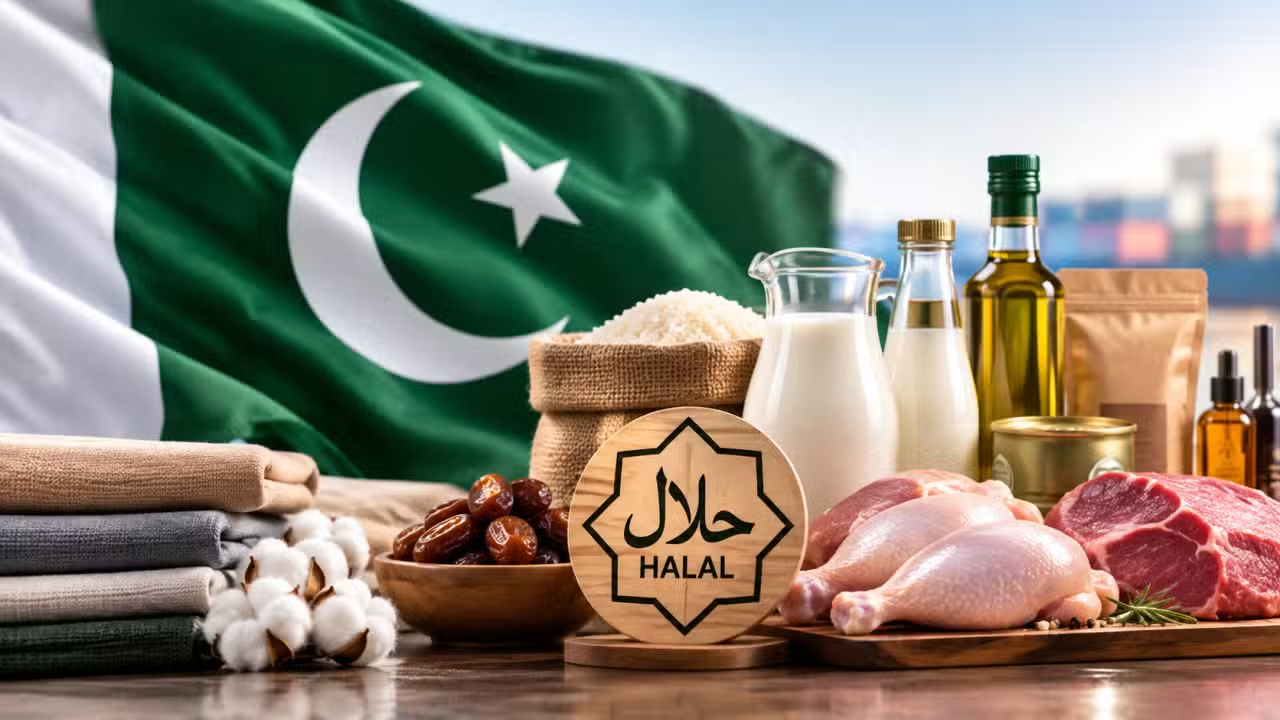
The government is seeking to strengthen Pakistan’s position in the global halal economy by encouraging local halal businesses to identify international markets where they can compete, expand and build long-term growth.
Finance Minister Muhammad Aurangzeb emphasized the importance of a targeted approach during a meeting with Islamic Chamber of Commerce and Development Secretary-General Shaikh Yousef Hassan Khalawi. The discussions focused on increasing Pakistan’s presence in the rapidly expanding global halal market.
Rather than pursuing international markets broadly, the government wants Pakistani businesses to focus on specific halal products, industries and countries where they have strong potential to compete. This approach could help companies direct investment and resources toward markets with greater commercial opportunities.
The halal economy covers a wide range of sectors, including food and beverages, pharmaceuticals, cosmetics, tourism, personal care products and other consumer goods. Pakistan’s large agricultural and manufacturing base provides local businesses with opportunities to develop products for international halal consumers.
The government’s focus on global competitiveness also highlights the need for Pakistani companies to meet international standards. Consistent quality, reliable certification, modern packaging and compliance with importing countries’ regulations can play an important role in helping local brands establish themselves overseas.
For Pakistani halal businesses, access to international markets could create opportunities to increase exports and diversify the country’s export base. Developing stronger halal brands could also help businesses move beyond traditional markets and reach consumers in countries where demand for certified halal products is growing.
The meeting with the Islamic Chamber of Commerce and Development reflects the importance of cooperation with international Islamic business organizations. Greater engagement with such institutions could help Pakistani companies better understand market requirements and identify potential trade and investment opportunities.
Pakistan already has significant potential in halal food and related industries because of its agricultural resources, food-processing capacity and large domestic consumer market. However, competing globally requires businesses to focus on value addition, product quality, branding and efficient supply chains.
A country-specific strategy could help companies understand which products are most suitable for individual markets. Different countries have different consumer preferences, certification requirements and import regulations, making targeted market research essential for successful expansion.
The government’s latest emphasis suggests that Pakistan wants to approach the halal economy as a major international business opportunity rather than limiting it to domestic consumption. If supported by effective policies and private-sector investment, the strategy could help Pakistani companies increase their international footprint.
For local halal businesses, the global market presents both opportunities and challenges. Companies that can combine internationally recognized certification with competitive pricing, dependable quality and strong branding may be better positioned to win customers abroad.
The push for global expansion also comes at a time when businesses are increasingly looking toward export-led growth. A stronger presence in the international halal economy could contribute to Pakistan’s trade ambitions while creating new opportunities for manufacturers, exporters and entrepreneurs.